Roxanne, the draft screenplay

Updated: May 25
In 2014, I was amazed to discover that Steve Martin had published his screenplays to Roxanne and LA Story as a book … in 1997!
There was virtually no publicity about the book, at least that I can find, and certainly nothing was reported about it at the time in Nelson, where significant portions of Roxanne were filmed in August 1986.

Most interesting to me, the script contained several scenes that aren’t in the movie, some of which were filmed but didn’t make the final cut.
It’s not clear if the book contains the final shooting script. I assume it does, but there are no notations to verify this. Significantly, the script describes the setting as Nelson (Washington, not BC).
I wrote a story about the script for the Nelson Star, which seems to have disappeared from the newspaper’s website, but you can view it here on the Wayback Machine.
More recently, I was further amazed to discover an earlier draft of the screenplay on eBay. It was one of many scripts someone in California was selling, but I have no idea how they acquired it.
In 1990, Martin donated his Roxanne drafts, revisions, and the final shooting script to the Harry Ransom Humanities Research Centre at the University of Texas. It was a lot cheaper to buy the script on eBay than visit Texas, so that’s what I did.
Martin once told the New York Times that he started thinking about a modern adaptation of Cyrano de Bergerac in 1983 and wrote ten drafts of his screenplay before he showed it to Columbia Pictures in 1985. He then wrote another 15 drafts, although some of those only had a few scenes altered.
Where does the version I bought fall among those drafts? Somewhere between No. 11 and No. 25, it appears. It’s labelled a “Revised draft” and dated July 1985, although the tops of pages 1-46 say March 23, 1985 and pages 47 onward say May 23, 1985.
Roxanne was the first screenplay Martin wrote on his own, and he said the key was finding the courage to discard things that weren’t working. Martin also said the finished movie was peppered with material improvised on set. He found it “almost depressing” how many big laughs came from those bits, as opposed to the scenes he had long laboured over.
The script in the 1997 book was similar enough to the finished movie that I enumerated virtually all the differences for my Nelson Star story. But the earlier script has too many differences to list them all. It still has many similar scenes to the movie, but often they are in a different order, with different dialogue.
Oddly, the second page of the draft script has a photo of Martin wearing his fake nose. How did that come about, given that shooting of the film was more than a year away? Was he testing out prosthetics to inspire his writing? (In 2015, an unused foam latex nose from the movie sold at auction for $184. It’s the only surviving prop that I’m aware of.)
The first page of the script reveals the movie was originally set in Aspen, Colorado, where Martin lived in the 1970s. It’s presumably coincidental that Nelson and Aspen are both two-syllable names that end in N, but it’s not a coincidence that both are known for skiing. Martin told the Times that a ski town was “the perfect size and everybody hung out in the same place.”
A big surprise appears on the first page: although as in the movie, Martin’s character is the fire chief, he isn’t yet named C.D. Bales (a nod to Cyrano de Bergerac). Here he’s Henry Hudson. Yet the characters Roxanne and Chris are both present, both of whom take their names from counterparts in Cyrano.
The script in the book opens with a tour around town where we meet the unctuous mayor and a group of older women obsessed with the TV show Dallas. The draft script opens “Two years earlier,” but with the same scene as in the movie. Henry (who I’m just going to refer to as Steve Martin from now on) is accosted by some drunks. In this version there are three of them, rather than the two that appear in the movie. After making short work of them, Martin is heard calling the police or ambulance from the fire hall and suggesting:
If you hurry you can pick up three men in the alley behind Culverson’s … I think they’ll be there another 15 minutes at least. They’re resting.
In the movie, Roxanne (played by Daryl Hannah) shows up at the fire hall, having been locked out of her house naked. She declines the offer of a coat, and then, to her chagrin, she has to explain she was being ironic. Martin’s response is one of the most famous lines in the film:
Oh, ho, ho, irony! Oh, no, no, we don’t get that here. See, people ski topless here while smoking dope, so irony’s not really a high priority. We haven’t had any irony here since about, ’83, when I was the only practitioner of it. And I stopped because I was tired of being stared at.
Inexplicably, I wrote in the Nelson Star story that this line isn’t in the final script. But it is! A version also appears in the earlier script:
Miss, one doesn’t run into a lot of irony in Aspen. People ski topless here. You better tinge your irony with sarcasm so’s I’ll know when you’re doing it.
In both this script and in the movie, Roxanne’s reaction is the same: “Oh, brother.”

In the movie, Martin arrives at Roxanne’s house and opens his tool box to reveal it contains only a credit card. He jimmies the door unsuccessfully and declares “This lock doesn’t accept Mastercard.” He (or his stunt double, Robert Jauregui) then launches an acrobatic assault on the house to reach an open window. In the draft script, though, he simply opens the door with a crowbar.
In the script, once inside, Roxanne reveals she’s a college instructor in Denver who comes to Aspen each summer to write. She’s also about to get married. Martin in turn reveals he’s the local gossip columnist, Aunt Shirley. Roxanne quotes something she read in Aunt Shirley’s column that amused her:
I would rather be with the people in this town than with the finest people in the world.
This joke turns up in the movie in a speech by Mayor Deebs (played by Fred Willard), who delivers the line sincerely. Deebs is also a volunteer firefighter who is both guileless and clueless, but in the draft script, Mayor Black is a sinister presence, whom Aunt Shirley refers to as “the wombat.”
We flash forward two years in the script and see professional firefighter Chris Macconnell (Rick Rossovich in the movie) getting off a plane and being met by another firefighter, Johnson. The script also has a character named Chuck. In the movie, Johnson and Chuck are combined into a single skeevy character (played by John Kapelos). Some of Chuck’s creepy pick-up lines in the movie are given to Johnson in the script. Johnson is also a singer of some ability.
In the script, Roxanne rents a house from a local realtor, Gertie, who is part of the group of Dallas fans. Gertie is also Roxanne’s confidante, a role that would later be assigned to local cafe proprietor Dixie (played by Shelley Duval).
Also in the script, Roxanne is anticipating the arrival of Halley’s Comet, which would set the movie in 1986, the last time the comet appeared in our part of the solar system. Because the movie didn’t come out until 1987, this was altered to have Roxanne searching for another comet, which she ultimately finds and names Kowalski, after her own last name. In the draft script, Roxanne’s last name is Sheppard.
One of the locations in the script is an opera house, described as “this hundred year old building” with a nightclub downstairs. When location scouts came to Nelson, they were initially interested in the Boiler Room nightclub in the basement of the Hume Hotel. But the nightclub scenes were actually filmed at Richards on Richards in Vancouver.
In the script, the nightclub is where we first meet married couple Ernie and Dixie Samuels. In the movie, Dixie’s last name is never revealed, although a press kit calls her Dixie Smith. The published script refers to Ernie as one of her cafe staff and Jack as her ex. In the movie, the waiter is called Bernie and we never learn about Jack.

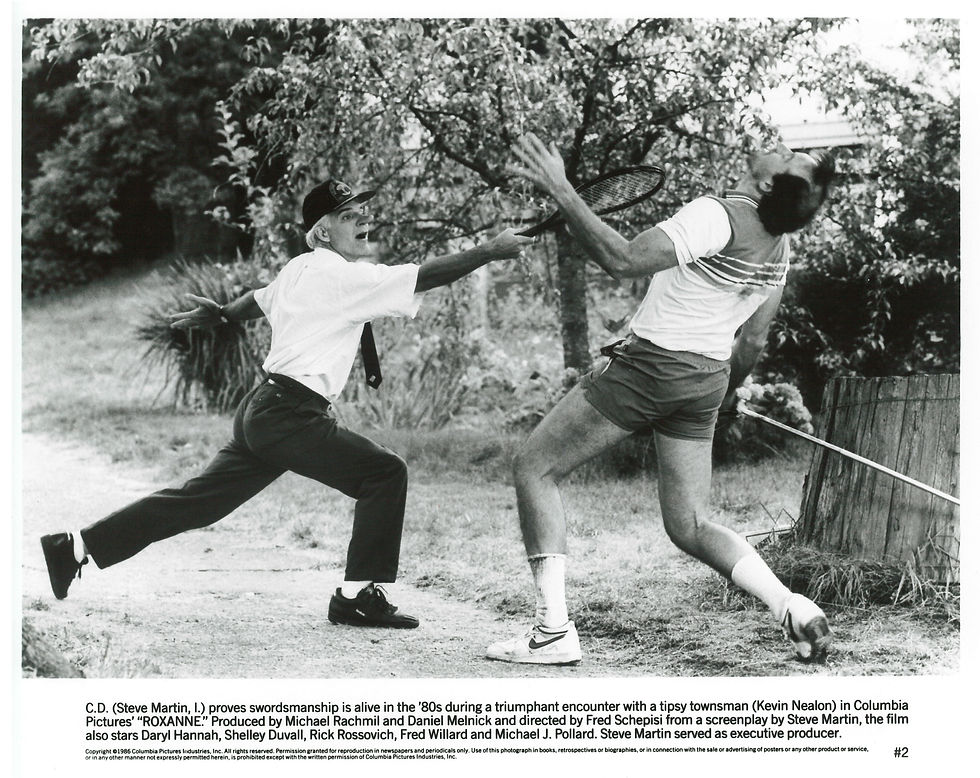
Johnson performs on stage but is heckled by drunks, one of whom throws a beer bottle at him. Martin catches it, takes a sip, and then returns it to the drunk, who confronts Martin: “You better sit down, big nose.” What follows is a direct parody of Act I of Cyrano de Bergerac, where the Viscount says “Sir, you have a very big nose!” and Cyrano replies by providing 18 better insults.
In the movie, Martin promises he can offer 20 better insults — including one that is taken directly from Cyrano: “Oh, how you must love the birds! I see you’ve made them a nice perch for their tiny feet.” In the movie, it’s rendered as: “You must love the little birdies to give them this to perch on.”
Martin has rattled off 19 insults in the movie when he asks for a tally. “Fourteen, chief!” someone replies. Martin then gives six more for a total of 25. In the published script, there are actually 32 insults and when Martin calls for a count, he’s already at No. 26.
Yet in the earlier script there are just five insults, four of which appear in the published script and three of which appear in the movie:
• Watch it! With an eraser like that, there must be a mighty big pencil around here somewhere.
• Well, here we are, just the three of us.
• You know, it might de-emphasize your nose if you wore something larger, like Wyoming.
• Hi, I’m Earl Scheib and I can paint that nose for $39.95!
Mercifully, the fifth one didn’t make it into the published script or the movie:
B’wana! B’wana! Someone’s stolen one of our spears! [Calling off] Forget it fellows, I found it!
There is no indication in the draft script that Martin planned to expand the list, even though the quantity of insults is what makes the scene so effective. It’s also truer to the source material.
There is some intrigue around another insult that appears in the published script, but not in the movie.
In 2022, Martin and cartoonist Harry Bliss released a book called Number One is Walking, which recounted an anecdote from the filming of Roxanne. (Martin also described it during an appearance on The View, seen below.)
He said he walked into a bar (based on his description, it was probably the Civic Hotel) to use the washroom, while wearing his enormous nose. Two outlaw biker-types stared at his nose. Martin braced himself for a comment of the sort he had already heard many times. Instead, one of the men asked “Why the long face?”

But what is surprising is that the same insult is in the script published in 1997.
Sad: Oh, why the long face?
This is hard to reconcile with the anecdote. Did Martin misremember the incident in the book? Or did he add the joke to the script upon hearing it? And if so, does that mean the script published in 1997 includes material that wasn’t there when shooting began? I don’t know.
In the draft script, the bar scene comes before Martin realizes Roxanne has returned to town, whereas in the movie he’s well aware that she’s in the crowd. In the script, Dixie informs him Roxanne is back and has split up with her husband, whom Dixie describes as “That bearded thing from hell.”
Also in the draft script, the police chief is called Ralston. This character doesn’t exist in the published script or movie, but the name was assigned to a firefighter played by Steve Mittleman, who warns Chris to avoid staring at Martin’s nose.
Ralston, the police chief, is in cahoots with Mayor Black. They plan to hire an arsonist to burn down the opera house. We learn the fire department has just switched from professionals to volunteers because Ralston and Mayor Black want it to be as amateurish as possible to ensure the building burns. Why they want it gone is never explained.
A scene that follows demonstrates the competence level that the department operates at. It doesn’t appear in the published script or the movie.
We see a cheerfully quaint, old-fashioned fire station. We see a sign out front that reads “Aspen Fire Department.” There is, however, a fireman, BORIS, on a ladder, starting to nail up the letters for the word Volunteer after the word Aspen. There is another fireman, ANDY, standing out talking to him.
BORIS: Hey Andy, is volunteer spelled v-o-l-i-n-t-u-a-r or v-o-l-a-n-u-t-u-n-a-r?
ANDY: (stuck) Uh … let’s see, v-o-l … uh, why don’t you just abbreviate it, v-o-l, period?
BORIS: But that’s the abbreviation for volume. They might think it’s the Aspen volume fire department.
ANDY: Only an idiot would think that.
BORIS: Okay.
He tacks up a final period on VOL. A third fireman, DEAN walks out of the firehouse.
DEAN: Hey, what’s the Aspen volume fire department mean?
In the next scene, Andy and another firefighter burn some oily rags in a can. But they are distracted by a buxom woman named Rita, and the fire spreads. Martin spots it and puts it out. In the movie, an abbreviated version of this scene happens near the beginning.
Rita returns a little later in the draft script. Martin deduces she’s hiding in a locker, having given some of the firefighters a command performance of her strip tease.

The draft script has a page 46A and 46B, suggesting an alteration to a scene where Chris goes to a bookstore (this is also where the dates atop each page change from March 23 to May 23). In this version, Chris buys a book that Roxanne has written about Halley’s Comet. He’s buying it for Martin, but when word gets back to Roxanne, she assumes Chris was the one who wanted it. In the movie, Chris buys a book by Sartre on behalf of another firefighter who is too embarrassed to buy it himself.
One bit that failed to make the published script or the movie was a prank to initiate Chris as a firefighter. His colleagues tell him that dogs have started exploding at a hardware store after drinking kerosene. They send Chris in, who nervously points his hose at a puzzled mutt.
Eventually, Chris asks Martin to write love letters to Roxanne for him, since he finds it impossible to approach her. In the script, Chris is aware he’s not the brightest bulb.
I hear about war in the Middle East, and I don’t know where the Middle East is. I just know it’s in the east, around the middle. For two years, I pronounced “anxiety,” “an-ex-ity.” However, I ski great.

In the draft script, but not in the book version or the movie, Roxanne asks Martin for help writing back to Chris. He declines, telling her:
I don’t like to meddle in other people’s business. That’s one of my rules.
In both the earlier and the later versions of the script, but not in the movie, we see a montage of the volunteer firefighters at their day jobs before being called to an alarm — which turns out to be a cat in a tree. Their inept response is in the movie, and it’s a scene I watched being filmed.
The draft script has the mayor and police chief sending thugs to harm Martin. He avoids the ambush by taping a sausage to a wall to mimic his nose and then chases them off with a fire truck. Which would have been an amusing scene, but difficult to execute.
Another dramatic part that was deleted before the script was published: the mayor hires yet another group of thugs to tamper with Martin’s car. Later, the police chief notices someone running a red light and commandeers the car. He discovers it has no brakes and crashes into the mayor’s house.
In the draft script, Chris and Roxanne finally have an excruciatingly awkward encounter on her veranda. But at this point the scene is missing what ultimately makes it so funny in the movie: Martin radioing Chris to tell him what to say, with Chris’ earpiece hidden under a hunter’s cap. When a police dispatcher’s frequency interferes with the transmission, Chris is too dumb to realize it and Martin can only listen in horror.
Near the end of the movie, the fire department uncharacteristically proves its mettle by saving a cow from a burning barn. In the draft script, the arsonist strikes at the opera house. (Here I might mention that, coincidentally, Nelson’s opera house at the corner of Victoria and Ward streets burned down in a spectacular fire in April 1935.)
I can’t remember who gave me these prints of the barn-burning scene, but they were probably taken by Nelson Daily News photographer Steve Thornton, who had special access to the set. These are a representative sample from among dozens of shots. The barn was built in the newspaper’s parking lot. Next to it was a gazebo that figured in a deleted scene about a “You are here” sign. Pictured above are Michael J. Pollard, Max Alexander, Fred Willard, Steve Mittleman, and Steve Martin.
In the movie, the barn fire is never seen as particularly menacing, except to the cow. In the draft script, though, several people are trapped inside the opera house. The mayor forbids Ralston from allowing anyone to enter. Ralston protests that no one was supposed to be inside when the match was lit. Martin ignores the mayor’s commandment.
Don’t get in the way of your Aunt Shirley!
He and his under-qualified firefighters go inside. As the script describes it:
The men fly to the rear of the building where they spot several people trapped by the flames. Henry PLUNGES into the flames and gets to one of them. He picks him up with the fireman’s hold and dashes through the wall of flame. The others act just as bravely, rescuing people right and left in a surprising display of skill and bravery.
In the finished movie, the pyrotechnics aren’t nearly as dramatic.
In the draft script, Martin blames the fire on the mayor, and in the final scene, Roxanne confronts Martin about the letters he has been ghostwriting for Chris. She hasn’t quite figured it out yet. When she finally does, she takes the revelation calmly. At that moment, Halley’s Comet appears.
In the movie, Roxanne learns the truth before the big fire and, more realistically, she is furious. She still gets over it rather quickly and forgives Martin too easily, but at least she’s given a few hours to consider it.

Overall, the final shooting script is a lot better than this draft, and the movie, despite its shortcomings, is better still. But the draft is a fascinating window into how the first and still best-known motion picture filmed in West Kootenay took shape. Steve Martin ultimately won a Writers Guide of America award for best screenplay based on material from another medium.


Great Article