The mysterious silver chalice
Updated: Apr 2
My grandfather John Balfour Gray owned and ran J.B. Gray Jeweller & Optometrist on Baker Street in Nelson from 1923 to 1950. The store motto was “Good Goods at Grays.”
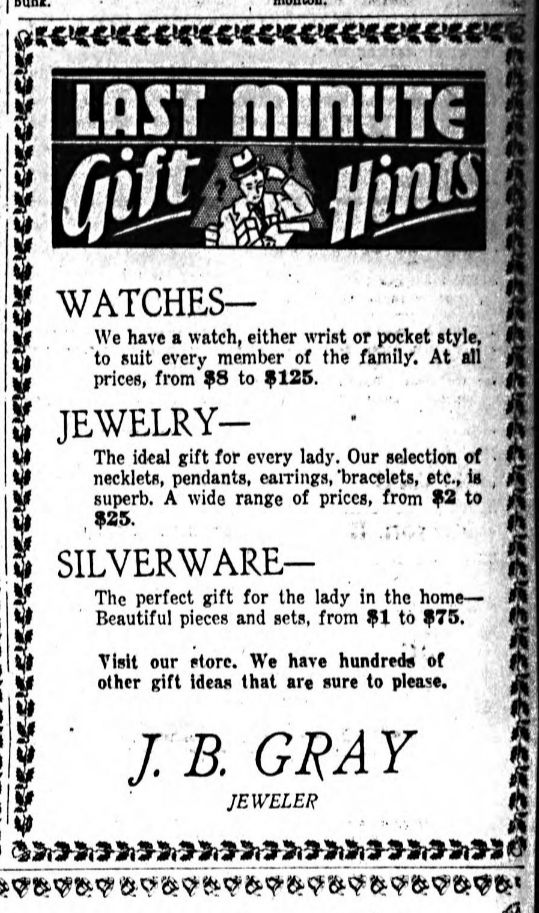
Nelson Daily News, Dec. 24, 1932
JB’s home was further along Baker Street where he lived with his wife Mina and three children, my mother Phyllis and sons Hampton and Jack. The store still exists as Ted Allen’s Jewellery. Inside the current store, a one-page history describes my grandfather:
John Balfour Gray held Nelson’s landmark jewellery store for more than a quarter of a century. A congenial man with a golden personality to match his stock of goods, Gray was known throughout the West Kootenay. Described as “invariably upbeat,” Gray never failed to raise the spirits of his colleagues and customers.”
The chalice is a sports trophy inscribed with the names of winning cricket teams. It is 26.5 cm tall. The upper cup is held by a claw, a bird’s leg with a spur is the stem and the base has feathers. Various male birds, including roosters, have spurs on the back leg which are commonly used for fighting. The symbolism for a sports trophy of male players is apparent.

How did I come to own the silver chalice?
It is unknown how it came to me other than I inherited it from my mother. It is mere supposition Phyllis inherited from her father and that presumption comes from her father owning a jewelry store.
JB made a living from selling and repairing goods. Times were hard economically during the Great Depression for everyone including retailers. Among the stories Mom told was that during that era, JB was also a pawn broker of sorts. The bus coming from outer communities stopped in front of his store. According to Phyllis, farmers who wanted their watches or clocks fixed asked JB if he could take items as collateral. With his “golden personality” and perhaps some desperation to make some money, he agreed.
This presumption about the chalice coming into his possession in Nelson may be entirely wrong since JB had lived and travelled in other places before settling in Nelson. He could have acquired it during his stint from 1901 to 1902 as a trooper in South Africa during the Boer War, in Scotland where he grew up and emigrated from in 1905 or from any of the places he lived in Canada prior to Nelson, such as the Prairies and New Westminster and Trail.
Given that it does not appear to be personally meaningful since JB was not a cricket player, I have no alternative plausible theories; for examples, it is a heavy item to carry around as one moves cities or countries and, from what I have heard about my grandfather’s character, I doubt that JB won it in a poker game. One other possibility, however, is that it may not have been JB’s at all, rather it might have come from someone else in the family.
Inscriptions
The chalice is a trophy cup for the Singapore Cricket Club. The winning teams are listed below as on the cup, going around right to left. Some names are inscribed in italics, inconsistency even within one list of winners. Fonts differ within one team’s listing or year. Inscriptions read:
Singapore Cricket Club
Single-Wicket Tournament
Won By
Civil Service November 1881
A.P Talbot
H.E. McCallum
E.W. Birch
E.M. Merewether
Army
June 1884
E. Druitt R.E.
R.H. Cholmondeley “Inniskillings”*
J.J. Purdon “ “
J.G. Mayne “ “
Civil Service July 1883
E.W. Birch
A.P. Talbot
E.M. Merewether
G.L. Bouchier
Civil Service
January 1885
E.W. Birch
A.P. Talbot
F.G. Penney
G.L. Bouchier
Civil Service May 1882
F.A. Swettenham
E.W. Birch
E.M. Metewether**
B.O. Dewland
Civil Service
January 1884
E.W. Birch
A.P Talbot
E.M. Merewether
G.L. Bouchier
Civil Service Dec 1882
E.W. Birch
E.M. Merewether
H.M Thompson
H.E. McCullum
Civil Service
October 1885
E.W. Birch
A.P Talbot
F.G. Penney
E.M. Merewether
* R.E. “Inniskillings” likely refers to The Royal Inniskilling Fusiliers, which was an Irish line infantry regiment of the British Army in existence from 1881 until 1968.
** Name misspelled – should be Merewether.
Eight tournaments and their winning teams
The cup was awarded only once in 1881 and 1883 but twice yearly in 1882, 1884 and 1885. The Army won the tournament just one time (June 1884) and the Civil Service team won the remaining seven times in November 1881, May and December 1882, July 1883, January 1884 and January and October 1885.
There are 13 distinct personal names inscribed on the cup. Since the Army was a winning team only once during this period, each of these names appear only once: E. Druitt and the three labelled as “Inniskillings”: Cholmondeley, Purdon and Mayne.
Two civil servants (Birch and Mereweather) were listed on winning teams six times each; Talbot was on a winning team four times and McCallum and Bouchier twice each. Only four civil servants were on winning teams once: both Shettenham and Dewland in May 1882; Thompson in December 1882 and Penney in 1885.
The cup had no more room for names so perhaps another trophy was started in 1886.
Who are these people? Notes on names inscribed on the cup
Most of what I found came from general open sources such as Google and Wikipedia and are not verified. One seemingly more reliable source was One Hundred Years of Singapore [1]. These sources confirm that seven of those listed on the cup were in Singapore during the period 1880-1885 and many were civil servants or cadets.
In 1826, the three British territories of Singapore, Penang and Malacca were grouped into a single administrative unit, the Straits Settlements. Originally established as part of the territories controlled by the British East India Company, the Straits Settlements came under control of the British Raj in 1858 and then under direct British control as a Crown colony in 1867.
Among the many cadets sent from Britain in early 1880s to the Straights Settlement were F.A. Swettenham, A.P. Talbot, F.G. Penney, E.M. Merewether and E.W. Birch. In 1880 or 1881, an efficient brigade was organised and among the volunteer officers was the future governor of Ceylon (then Captain) H.E. McCallum. Frederick Gordon Penney was appointed a cadet S.S. in 1876 and was the first cadet to become colonial secretary.
Similar surnames did show up in Nelson. There is a Merewether House, which is a historic residence at 616 4th Street, and there were Talbots and others. But these are common British names and many British settled in the Kootenays in the early 1900s.
The Singapore Cricket Club and its trophy cups
For many years, I felt a tinge of guilt having this prize trophy in my possession since I was not from Singapore and have never played cricket. My daughter Marcia had one spare day in Singapore in the early 2000s on her way to New Zealand. With free time, it’s sometimes easier to get to know a city or site if you have a mission. Marcia readily agreed to my request to visit the Singapore Cricket Club to inquire if they wanted to have the cup. Marcia was successful in finding the club. Their reply to receiving it back was: “Heck, no. We have boxes of them in our basement.”
The cup’s current use
The silver chalice sits in an honored place on the fireplace mantel. Since being rejected by the Singapore Cricket Club, I have held no guilt about my owning and enjoying it. The mystery of its route to my house eludes me still. It has been used as a gong because its heavy metal makes a nice sound. I have used it a few times to drink from, most fun being to fill it with a little Scotch whisky and pass it around amongst a group of friends — hopefully with at least three other people, although if I am included, the group cannot be all male. Using the chalice to share a wee dram of Scotch seems especially fitting with the history posted in Ted Allan’s Jewellery which describes J.B. Gray as never failing “to raise the spirits.”
[1] One Hundred Years of Singapore: Being Some Account of the Capital of the Straights Settlements from its Foundation by Sir Stamford Raffles on the 6th February 1819 to the 6th February 1919, Vol. 1, General Editors: Walter Makepeace, Dr. Gilbert E. Brooke, J Braddel. London: John Murray, Albemarle Street W., 1921 (viewable here,
accessed Dec. 3, 2025)
Anne George lives in West Vancouver. She is an associate professor emerita at the University of BC.


Comments