Little-known vestiges of lost Nelson buildings

Updated: Apr 2
There’s something very unusual about the northeast corner of Vernon Street in Nelson: it’s the only place in town that I know of where four separate buildings have stood.
The first was the Grand Central Hotel, built in 1897 and greatly expanded the following year. Although it was a large building, for some reason photos of it are hard to come by.

A fire in 1920 damaged the hotel but didn’t destroy it. However, owner J.A. Erickson immediately listed the building for sale, so I suspect it wasn’t insured and he couldn’t afford to make repairs. It ended up being torn down, but it’s not clear how quickly that happened.
In 1924, a garage and car dealership was built on the site. The business changed names several times: Smedley’s Garage (1921-24), Capitol Motors (1924-39), Sowerby-Cuthbert Ltd., aka Red Star Motors (1939-42), Cuthbert Motors (1942-51), and Superior Motors (1951-56).
The business had two distinct sections: a two-storey stone and brick building and, by 1930, an open section on the corner, where the gas pumps were.

The Kootenay Kilities march past Capitol Motors, circa 1930s. (R.T. Fraser photo courtesy Alistair Fraser)

Nelson Daily News, Feb. 18, 1939
In 1956, Overwaitea built a new supermarket on the site, the third such store in Nelson after Liberty Foods and Safeway. If it hadn’t already been demolished by this time, the portion of the garage on the corner, which stood on Block 66, Lots 23 and 24, was removed to make way for a parking lot. The new supermarket was constructed on Lots 21 and 22, where the stone-and-brick garage had been.

Nelson Daily News, Nov. 15, 1956
The store operated until July 19, 1972, when a huge fire destroyed the building. Photos show some of the walls still standing. They were made of brick, which makes me think they had been part of the former garage and were just stuccoed over.


Nelson Daily News, July 20, 1972

Nelson Daily News, July 25, 1972

Nelson Daily News, Aug. 5, 1972
The supermarket was replaced in 1977 by a new Nelson and District Credit Union, which had previously operated right next door. This building occupies Lots 21-24, so both the former supermarket site and the old parking lot.
But after the fire, a piece of a concrete wall at the rear was left standing for reasons unknown. (I think it was probably from Overwaitea, but it is conceivable that it was actually from the garage, which had a concrete rear addition.) On this wall a mural was painted in 2019, designed by Emily Horn, then a Grade 5 student at L’Ecole Sentiers-Alpins. Her image was chosen by credit union staff and it was painted by Horn and local artist Isabelle Houde.


Nothing was said at the time about the unusual canvas. But this is one of at least three examples in Nelson of bits of burned buildings that were incorporated into whatever replaced them.
Another example is at the rear of the BCAA building, at the corner of Baker and Josephine, where an addition to the Johnstone Block stood until it burned on Dec. 1, 1976. I’m not sure when the addition was built, but it was around the turn of the 20th century. Still standing are part of a brick wall and chimney that are attached to the building next door. There’s a mural on it too, by Bubzee.

The third example is at 640 Baker. In 1899, Dr. G.A.B. Hall had a building constructed adjacent to the Tremont Hotel that used the same materials and same construction crew, and had a similar facade. The building, known as the Hall Block, was initially home to Brown & Co., a men’s clothing store.

The Hall Block is seen at far right, circa 1900. At far left is the long-gone cigar factory and next to it is the Tremont Hotel. Only the section on the far right survives, as Cartolina Cards. (Nelson Museum 57-01-067)
In 1912, the building became the Starland Theatre. Dr. C.E. Bradshaw, in his memoir recalled: “Here the orchestra played to silent pictures. The piano player was Mr. Johnson. Harold Brett played the violin and Irvin Davis played the drums. These were but three, but there were many more such as Jack Laughton, Len Friend and others.”
I was under the mistaken impression that no photos of the Starland existed, but in fact at least a couple do, taken during the Chahko Mika parade of July 1914. Like many theatres of its era, the Starland had an archway entrance. (The Gem Theatre further down the street was similar.) The photo also reveals a sign at the top of the building that said “Hall Block,” although it is not easily read below.
(Greg Nesteroff collection)
The Starland stopped operating as a moviehouse around 1924, but it continued to be used less frequently for political and religious meetings until 1930. The image below shows the same block circa 1936-39 with the arch boarded up.

(Nelson Museum 1986-138-016)
Famous Players still owned the building as of 1941 when the city asked the company to paint it, describing the front as “an eyesore on our main street.” Louis Hanic’s Home Furniture Exchange moved into the building in 1943. It was still a furniture store when the upper storey was destroyed by fire on May 26, 1976.
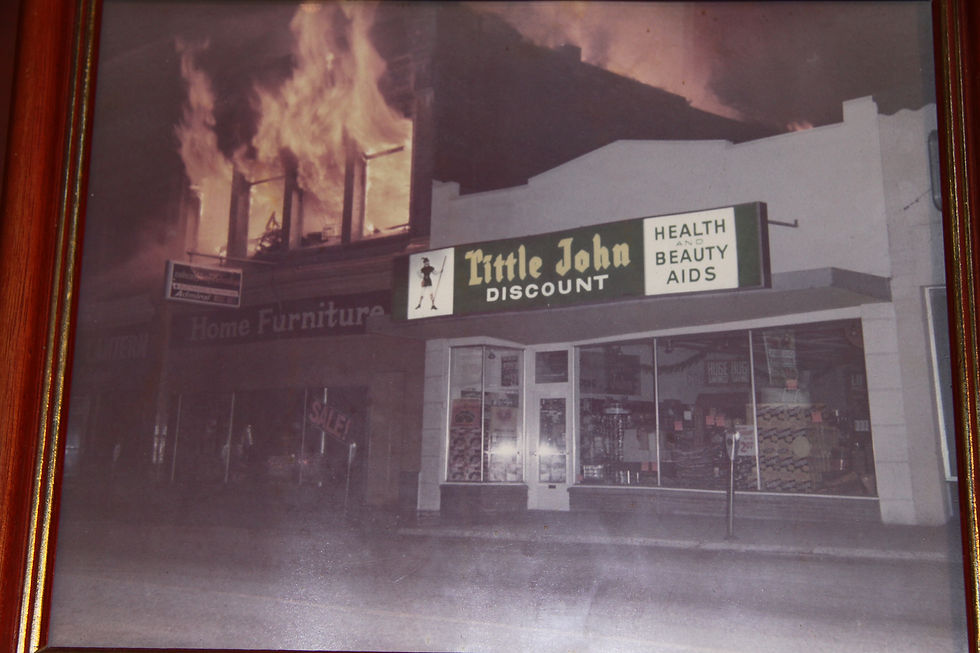
Home Furniture fire, 1976, as seen at the Nelson fire hall museum.

Nelson: A Proposal for Urban Heritage Conservation, 1981
In 1978, the building was redeveloped as the Keenan Block, which retained the scorched south wall of the former Hall Block. The front facade was completely redone, but I wonder if some of the bricks were salvaged from the fire, as their colouring also suggests scorch marks.

Updated on Feb. 24, 2026 to add the photos of the Hall Block in 1914 and circa 1936-39.


Amazing thanks
I miss Nelson every day
Some interesting photos
I always could tell the parts of old buildings still remain to no buildings and always wished I new the story
Now I do thanks 👍
I'm a proud Nelsonite
And I'm glad my kids are too and my wife 😁
My, that's a rough looking street surface in the Hall Block picture. It looks like large railway ballast. I think that they must have had a real problem with the underlying material to have put that there.
Don't know if there are any old photos of the Strathcona Hotel on Stanley St., I remember it went up in flames around the mid fifties. Thanks for posting the historical photos.
Another terrific post, Greg. Thank you. By the way, did you uncover any information about the Svoboda Block? Apparently it was located where DeVito's shoe store now sits. I have a personal interest because one of my uncles was connected somehow. I'm told by a relative that the Svobodas, Americans, built the block with money from two bags of gold they brought from the Klondike.