The Creston Valley Co-op and the Grand Theatre

This postcard of Creston taken between 1942 and 1947 appeals to me immensely for several reasons.

(Greg Nesteroff collection)
First, it shows the back of the Creston Valley Co-op on Canyon Street and a little alcove with a curved entrance that I am inordinately fond of. I’m not sure if it was originally a covered loading dock, but the alcove is still there, now providing some private parking spaces.

The co-op was established on Sept. 5, 1921. It had a store at Erickson before adding a second one on Canyon Street in Creston, which opened in the summer of 1926 and was soon expanded. Photos show a one-storey wooden store with a false front that became a much longer building, possibly made of concrete.

The Creston Valley Co-op is the second building on the left, while the Grand Theatre is the large building on the right. Circa 1930s. (Creston Museum and Archives)

The store burned down on Dec. 28, 1941, in a fire that threatened the entire business district. While it was a huge blow to the co-op, business resumed the next day in a bowling alley and a new co-op store was built on the same site, which opened on July 23, 1942.
The new store was designed in Art Moderne style and set back about 10 feet further from the street than the other businesses on Canyon Street, in anticipation that the entire street would one day be widened. (Eventually it was. That’s a whole other story.)
The co-op also expanded by buying the A.W. Burch store at Wynndel in 1947 and the Lister Trading and Supply Co. in 1949, running both as branches.

Creston Review, May 10, 1951

Nelson Daily News, Jan. 26, 1952
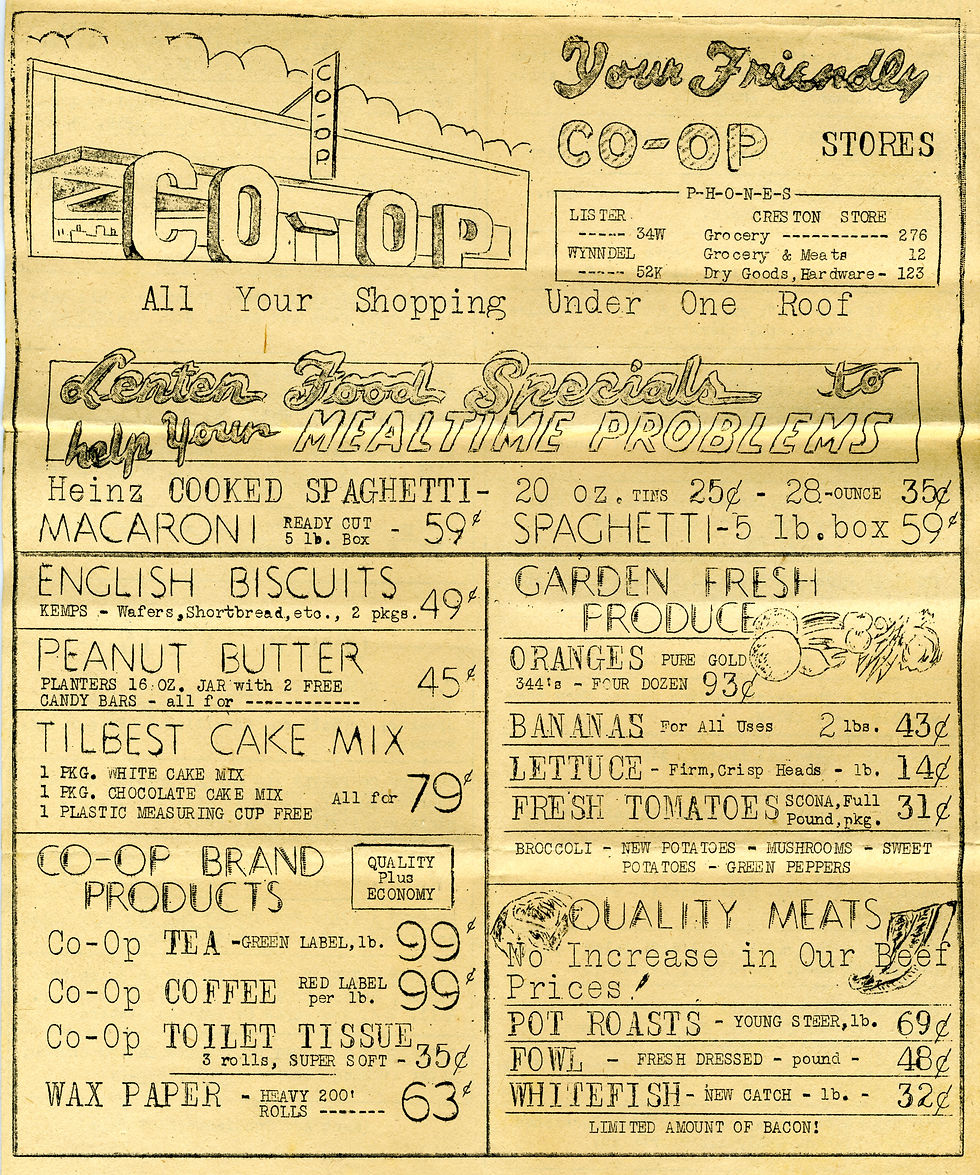
Creston Valley Advert, May 7, 1952
To the right of the co-op in the postcard at top is the home of longtime local physician Dr. George Henderson. It’s a wonder the home wasn’t also destroyed in the fire. (Its furniture was removed as the blaze burned away next door.)
The Henderson house eventually gave way to an expanded co-op, although for a long time I didn’t realize that was the case, because the addition was branded a Super-Valu. It opened on June 7, 1962. The co-op board explained to its members that securing a Super-Valu franchise was key to financing the expansion. To this end, a subsidiary was established called Supercrest Holding Ltd., but for all intents and purposes, Super-Valu and the co-op were joined at the hip — and also by an interior door. The older part of the co-op remained a department store.

The co-op in the 1960s. (Creston Museum and Archives)

Nelson Daily News, May 26, 1967

The co-op and Super-Valu in 1968. (Creston Museum and Archives)
In 1981, the co-op went bankrupt. But arrangements were made the following year to reopen the Super-Valu under private ownership. From at least the mid-1980s to the mid-1990s, the former co-op department store was a Fields store.
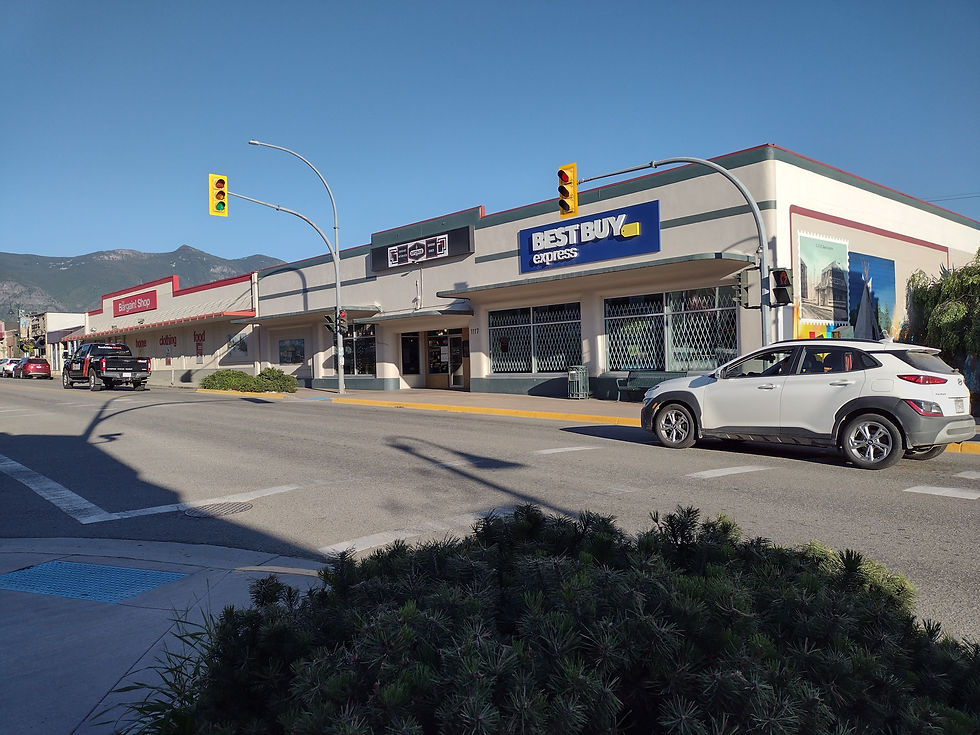
I don’t know when Super-Valu closed, but that part of the building is now the Bargain Shop, while the former Fields is home to Best Buy (formerly The Source) and a restaurant called Infernos (formerly Frisky Whisky). The building retains many of its original defining characteristics.
•
Across the street from the co-op, as seen in the postcard, is the Grand Theatre, built by the Rodgers family in 1920. This was Creston’s second dedicated moviehouse, replacing the short-lived Peekin Theatre, which the Rodgers also owned.

The Grand Theatre as it originally appeared, circa 1926. (Creston Museum and Archives)
In 1936, the Creston Board of Trade and village council agreed to split the cost of painting “Creston” in huge letters on two sides of the theatre’s peaked roof. As Helena White wrote in Sixty Bloomin’ Years: “Lighted at night, this would be an advertisement for the community and a direction guide for aerial travellers.”
I don’t know if the signs ever guided any pilots, but they remained in place until 1947, when the building’s top storey was lopped off. This coincided with both the widening of Canyon Street and what manager Floyd Rodgers described as “modernistic” plans for the theatre.
The Grand was probably the largest building to be pushed back as part of the street-widening program, and its move was reportedly completed without trouble. Renovations were then completed inside and out, rendering the theatre almost unrecognizable, though no less striking. In addition to a new facade, the lobby was moved from the corner of the building to the middle, and 16 feet were shaved off the stage.

The Grand Theatre after its 1947 makeover. (Creston Museum and Archives)
The Grand closed in 1960 following the death of Floyd Rodgers. Webster’s store, which had operated next door, expanded to take in the former theatre space. Webster’s subsequently became McDowell’s V&S department store.
In 2010, the building received a much-needed makeover and was turned into Pharmasave. Windows were restored to the second storey and a more inviting entrance was created. The facade, which had long been connected to the neighbouring building, once again stood alone.
It’s incredible that the building still stands at all, having survived both the co-op fire across the street in 1941 (according to a newspaper account, “at times the front of the Grand Theatre burst into flame”), and another fire in 1938 that destroyed the Hiway garage, a snack shop, lunch counter, and variety store. The Grand, separated from the flames by a vacant lot, was “scorched,” but saved.
Other than high ceilings, there are no obvious signs of the drug store’s former use as a theatre. A date was added to the top of the building that says 1919, but it should say 1920. (The same mistake appeared in the Creston Review’s special edition of 1951.)


The Grand and the Alcove in the Co-op are likely appealing as Art Deco which evokes a feeling of nostalgia.